


Sync Read/Write Tutorial <C++>
NOTE: This tutorial is based on XL-430-W250 DYNAMIXEL motors and uses Protocol 2.0.
This section provides examples of how to write code in C++ to sync_read and sync_write data to DYNAMIXEL motors.
Sync Read/Write allows simultaneous access to the same address on multiple DYNAMIXEL motors.
We need two motors to operate simultaneously.
Make cpp file
- Create a CPP file and open it in a text editor. In this case, we use visual studio code, but you can use any text editor you prefer.
$ mkdir -p my_dxl_project/src
$ cd my_dxl_project/src
$ code my_sync_read_write.cpp
- Open Visual Studio and create a new project as a Console Application.
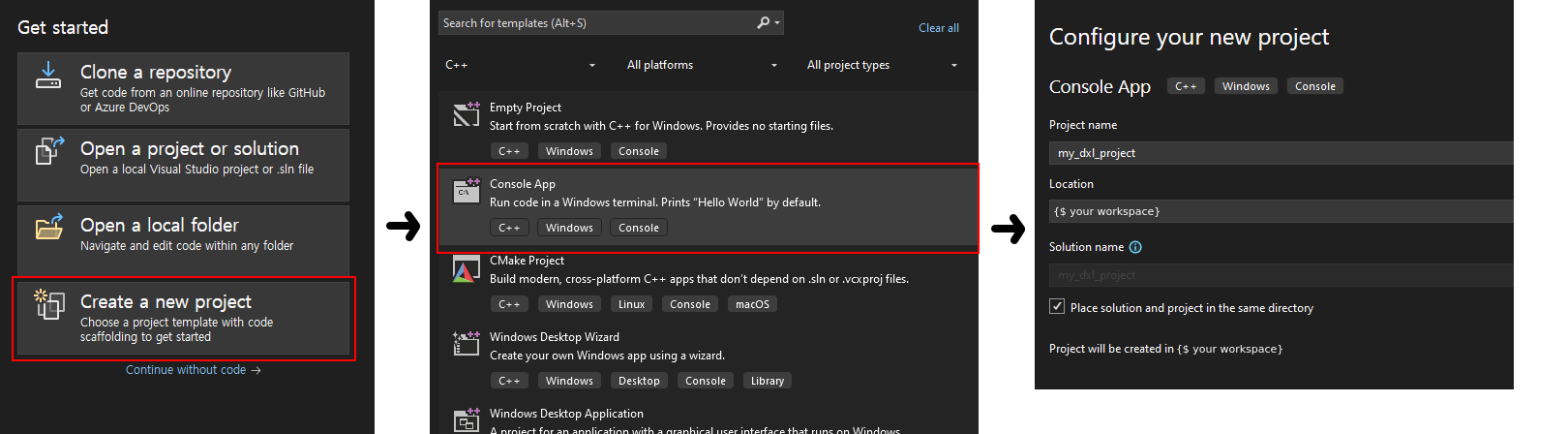
Source Code Description
Add Header Files
- Add
dynamixel_sdk/dynamixel_sdk.hto the top of your CPP file. This header file includes all necessary functions and classes from the DYNAMIXEL SDK.#include "dynamixel_sdk/dynamixel_sdk.h" #include <iostream>
Initialize Handler Objects
- Make main function and initialize the
PortHandler,PacketHandler,GroupSyncWriteandGroupSyncRead. Set theport nameandprotocol versionaccording to your DYNAMIXEL setup. The example below uses/dev/ttyUSB0as the port name and2.0as the protocol version.int main(){ dynamixel::PortHandler *portHandler = dynamixel::PortHandler::getPortHandler("/dev/ttyUSB0"); // your dxl port name dynamixel::PacketHandler *packetHandler = dynamixel::PacketHandler::getPacketHandler(2.0); //protocol version uint16_t goal_position_address = 116; uint16_t present_position_address = 132; uint16_t data_length_4byte = 4; dynamixel::GroupSyncWrite groupSyncWrite(portHandler, packetHandler, goal_position_address, data_length_4byte); dynamixel::GroupSyncRead groupSyncRead(portHandler, packetHandler, present_position_address, data_length_4byte);
- Make main function and initialize the
PortHandler,PacketHandler,GroupSyncWriteandGroupSyncRead. Set theport nameandprotocol versionaccording to your DYNAMIXEL setup. The example below usesCOM3as the port name and2.0as the protocol version.int main(){ dynamixel::PortHandler *portHandler = dynamixel::PortHandler::getPortHandler("COM3"); // your dxl port name dynamixel::PacketHandler *packetHandler = dynamixel::PacketHandler::getPacketHandler(2.0); //protocol version uint16_t goal_position_address = 116; uint16_t present_position_address = 132; uint16_t data_length_4byte = 4; dynamixel::GroupSyncWrite groupSyncWrite(portHandler, packetHandler, goal_position_address, data_length_4byte); dynamixel::GroupSyncRead groupSyncRead(portHandler, packetHandler, present_position_address, data_length_4byte);
Open Port and Set Baud Rate
- Open the port and set the baud rate. The example below uses
57600as the baud rate.portHandler->openPort(); portHandler->setBaudRate(57600);
 ERROR LOGGING
ERROR LOGGINGopenPort() and setBaudRate() functions return a boolean value indicating success or failure. If you want to check for failure, you can write like below to print an error message and exit the program.
if (portHandler->openPort()) {
std::cout << "Succeeded to open the port!\n";
} else {
std::cout << "Failed to open the port!\n";
return 0;
}
if (portHandler->setBaudRate(57600)) {
std::cout << "Succeeded to change the baudrate!\n";
} else {
std::cout << "Failed to change the baudrate!\n";
return 0;
}
Write data to turn torque on
- Turn on the torque of the DYNAMIXEL.
uint8_t dxl_id1 = 1; uint8_t dxl_id2 = 2; uint16_t torque_on_address = 64; uint8_t data = 1; // 1 to turn on the torque, 0 to turn off packetHandler->write1ByteTxRx(portHandler, dxl_id1, torque_on_address, data); packetHandler->write1ByteTxRx(portHandler, dxl_id2, torque_on_address, data);id: Dynamixel ID you setaddress: The address of the data you want to write. Refer to the Control Table of your DYNAMIXEL model, which can be found in its specification manual or Dynamixel Wizard 2.0. In this example, we use X series.data: The data you want to write to the specified address.
ERROR LOGGING
ERROR LOGGINGwrite1ByteTxRx() returns a communication result. If you want to check the communication result and error, you can write the code as shown below.
The dxl_comm_result, dxl_error variable should be declared beforehand.
uint8_t dxl_error = 0;
int dxl_comm_result = COMM_TX_FAIL; //COMM_TX_FAIL is a constant defined in the SDK
...
dxl_comm_result = packetHandler->write1ByteTxRx(portHandler, dxl_id1, torque_on_address, data, &dxl_error);
if (dxl_comm_result != COMM_SUCCESS) {
std::cout << packetHandler->getTxRxResult(dxl_comm_result) << std::endl;
} else if (dxl_error != 0) {
std::cout << packetHandler->getRxPacketError(dxl_error) << std::endl;
} else {
std::cout << "Dynamixel#1 has been successfully connected \n";
}
dxl_comm_result = packetHandler->write1ByteTxRx(portHandler, dxl_id2, torque_on_address, data, &dxl_error);
if (dxl_comm_result != COMM_SUCCESS) {
std::cout << packetHandler->getTxRxResult(dxl_comm_result) << std::endl;
} else if (dxl_error != 0) {
std::cout << packetHandler->getRxPacketError(dxl_error) << std::endl;
} else {
std::cout << "Dynamixel#2 has been successfully connected \n";
}
Add parameters to GroupSyncRead
- Add the DYNAMIXEL IDs to the
GroupSyncRead.groupSyncRead.addParam(dxl_id1); groupSyncRead.addParam(dxl_id2);
ERROR LOGGING
ERROR LOGGINGaddParam() returns a communication result as boolean. If you want to check the communication result and error, you can write the code as shown below.
The dxl_addparam_result variable should be declared beforehand.
bool dxl_addparam_result = false;
dxl_addparam_result = groupSyncRead.addParam(dxl_id1);
if (!dxl_addparam_result) {
std::cout <<"[ID:" << (int)dxl_id1 <<"]groupSyncRead addparam failed" << std::endl;
return 0;
}
dxl_addparam_result = groupSyncRead.addParam(dxl_id2);
if (!dxl_addparam_result) {
std::cout <<"[ID:" << (int)dxl_id2 <<"]groupSyncRead addparam failed" << std::endl;
return 0;
}
Get User Input and Set Data
- Get user input for the target position.
int target_position; while(true){ std::cout << "Enter target position (0 ~ 4095): "; std::cin >> target_position; if(target_position == -1){ break; // Exit on -1 input } else if(target_position < 0 || target_position > 4095){ std::cout << "Position must be between 0 and 4095." << std::endl; continue; } - Since
addParam()requires auint8_t *as its input, the data must be provided as a byte array.uint8_t param_goal_position[4]; param_goal_position[0] = DXL_LOBYTE(DXL_LOWORD(target_position)); param_goal_position[1] = DXL_HIBYTE(DXL_LOWORD(target_position)); param_goal_position[2] = DXL_LOBYTE(DXL_HIWORD(target_position)); param_goal_position[3] = DXL_HIBYTE(DXL_HIWORD(target_position));
Add parameters to GroupSyncWrite
- Add parameter to the
GroupSyncWriteand transfer the data to the DYNAMIXEL.groupSyncWrite.addParam(dxl_id1, param_goal_position); groupSyncWrite.addParam(dxl_id2, param_goal_position); groupSyncWrite.txPacket(); groupSyncWrite.clearParam();
ERROR LOGGING
ERROR LOGGINGtxPacket() and addParam() returns a communication result. If you want to check the communication result and error, you can write the code as shown below.
The dxl_addparam_result, dxl_comm_result variables should be declared beforehand.
bool dxl_addparam_result = false;
int dxl_comm_result = COMM_TX_FAIL; //COMM_TX_FAIL is a constant defined in the SDK
dxl_addparam_result = groupSyncWrite.addParam(dxl_id1, param_goal_position);
if (!dxl_addparam_result) {
std::cout <<"[ID:" << (int)dxl_id1 <<"]groupSyncWrite addparam failed" << std::endl;
return 0;
}
dxl_addparam_result = groupSyncWrite.addParam(dxl_id2, param_goal_position);
if (!dxl_addparam_result) {
std::cout <<"[ID:" << (int)dxl_id2 <<"]groupSyncWrite addparam failed" << std::endl;
return 0;
}
dxl_comm_result = groupSyncWrite.txPacket();
if (dxl_comm_result != COMM_SUCCESS) {
std::cout << packetHandler->getTxRxResult(dxl_comm_result) << std::endl;
}
Read data to get current position
- Read the current position from the DYNAMIXEL until it reaches the target position.
int dxl1_present_position; int dxl2_present_position; do { groupSyncRead.txRxPacket(); dxl1_present_position = groupSyncRead.getData(dxl_id1, present_position_address, data_length_4byte); dxl2_present_position = groupSyncRead.getData(dxl_id2, present_position_address, data_length_4byte); printf("[ID:%03d] GoalPos:%03d PresPos:%03d\t[ID:%03d] GoalPos:%03d PresPos:%03d\n", dxl_id1, target_position, dxl1_present_position, dxl_id2, target_position, dxl2_present_position); } while((abs(static_cast<int>(target_position - dxl1_present_position)) > 10) || (abs(static_cast<int>(target_position - dxl2_present_position)) > 10)); } portHandler->closePort(); return 0; }
ERROR LOGGING
ERROR LOGGINGtxRxPacket() and isAvailable() returns a communication result . If you want to check the communication result and error, you can write the code as shown below.
The dxl_getdata_result, dxl_comm_result variables should be declared beforehand.
bool dxl_getdata_result = false;
int dxl_comm_result = COMM_TX_FAIL; //COMM_TX_FAIL is a constant defined in the SDK
dxl_comm_result = groupSyncRead.txRxPacket();
if (dxl_comm_result != COMM_SUCCESS) {
std::cout << packetHandler->getTxRxResult(dxl_comm_result) << std::endl;
}
You can also check if the data is available in the GroupSyncRead by using the isAvailable() function. If the data is not available, you can print an error message and exit the program.
dxl_getdata_result = groupSyncRead.isAvailable(dxl_id1, present_position_address, data_length_4byte);
if (dxl_getdata_result != true) {
std::cout << "[ID:" << (int)dxl_id1 << "] groupSyncRead getdata failed" << std::endl;
return 0;
}
dxl_getdata_result = groupSyncRead.isAvailable(dxl_id2, present_position_address, data_length_4byte);
if (dxl_getdata_result != true) {
std::cout << "[ID:" << (int)dxl_id2 << "] groupSyncRead getdata failed" << std::endl;
return 0;
}
Compile and Run
- Compile the code using g++.
$ g++ my_sync_read_write.cpp -o my_sync_read_write -ldxl_x64_cpp $ ./my_sync_read_write
-
Set build properties.
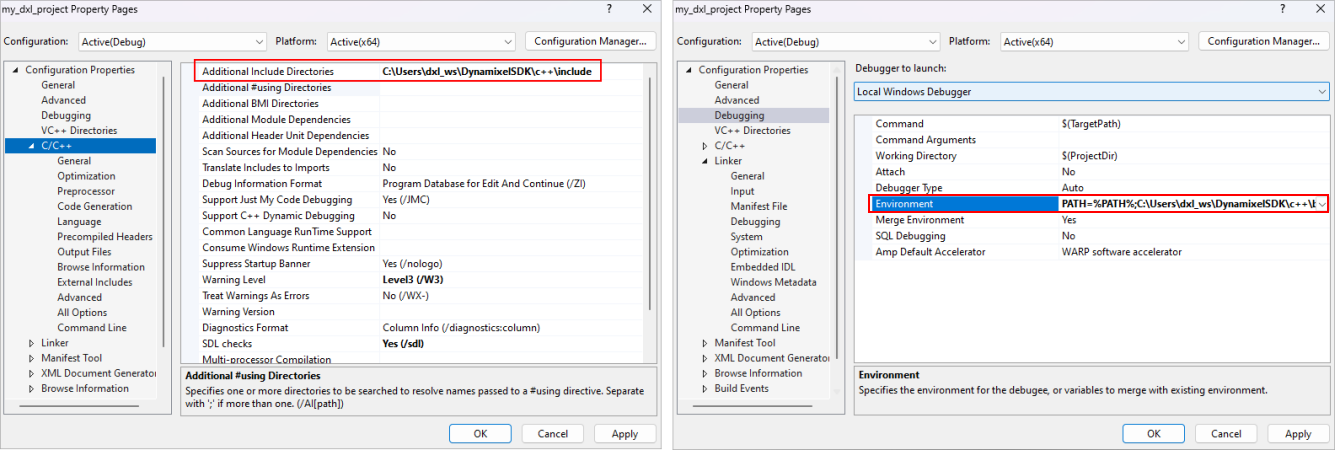
C/C++ → Additional Include Directories:{$Dynamixel_SDK_PATH\c++\include}Debugging → Environment:PATH=%PATH%;{$Dynamixel_SDK_PATH\c++\build\win64\output}(if you use 32bit architecture, use{$Dynamixel_SDK_PATH\c++\build\win32\output})
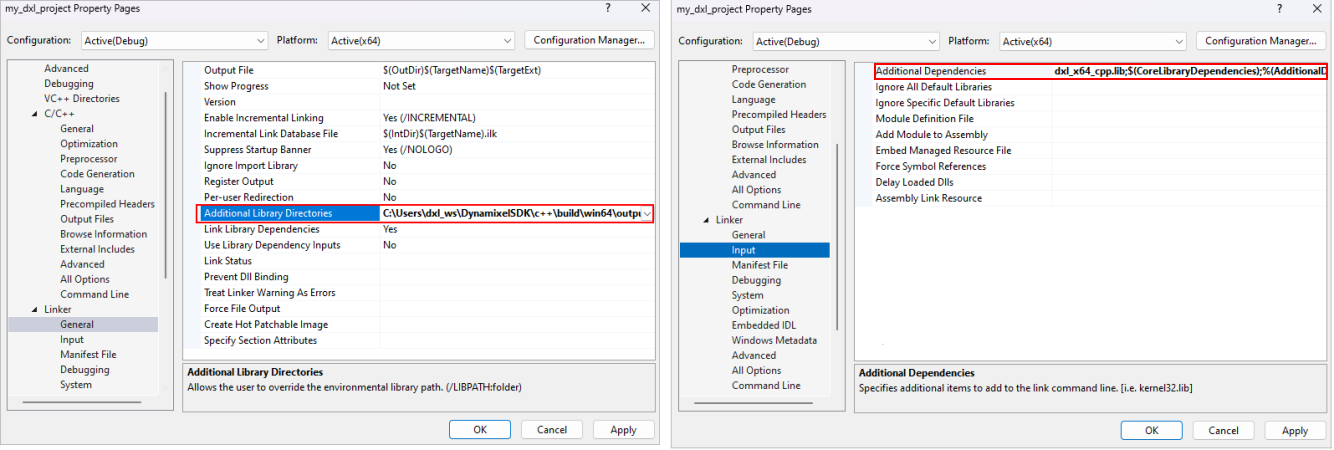
Linker→Additional Library Directories:{$Dynamixel_SDK_PATH\c++\build\win64\output}(if you use 32bit architecture, use{$Dynamixel_SDK_PATH\c++\build\win32\output})Linker→Input→Additional Dependencies:dxl_x64_cpp.lib
-
Build properties setup is complete. You can now build and run the project.

-
After building, you can find the executable file( .exe ) in the output directory :
{$YOUR_SLN_DIR\x64\}
WARNING: If you execute the .exe file directly(not through the IDE), you might encounter a missing DLL error. To fix this, ensure that dxl_x64_cpp.dll is either in your system PATH or in the same directory as the application.
Full Source Code
#include "dynamixel_sdk/dynamixel_sdk.h"
#include <iostream>
int main(){
  dynamixel::PortHandler *portHandler = dynamixel::PortHandler::getPortHandler("/dev/ttyUSB0"); // your dxl port name
  dynamixel::PacketHandler *packetHandler = dynamixel::PacketHandler::getPacketHandler(2.0); //protocol version

  uint16_t goal_position_address = 116;
  uint16_t present_position_address = 132;
  uint16_t data_length_4byte = 4;
  dynamixel::GroupSyncWrite groupSyncWrite(portHandler, packetHandler, goal_position_address, data_length_4byte);
  dynamixel::GroupSyncRead groupSyncRead(portHandler, packetHandler, present_position_address, data_length_4byte);
uint8_t dxl_error = 0;
int dxl_comm_result = COMM_TX_FAIL;
bool dxl_addparam_result = false;
bool dxl_getdata_result = false;
if (portHandler->openPort()) {
std::cout << "Succeeded to open the port!\n";
} else {
std::cout << "Failed to open the port!\n";
return 0;
}
if (portHandler->setBaudRate(57600)) {
std::cout << "Succeeded to change the baudrate!\n";
} else {
std::cout << "Failed to change the baudrate!\n";
return 0;
}
uint8_t dxl_id1 = 1;
uint8_t dxl_id2 = 2;
uint16_t torque_on_address = 64;
uint8_t data = 1;
dxl_comm_result = packetHandler->write1ByteTxRx(portHandler, dxl_id1, torque_on_address, data, &dxl_error);
if (dxl_comm_result != COMM_SUCCESS) {
std::cout << packetHandler->getTxRxResult(dxl_comm_result) << std::endl;
} else if (dxl_error != 0) {
std::cout << packetHandler->getRxPacketError(dxl_error) << std::endl;
} else {
std::cout << "Dynamixel#1 has been successfully connected \n";
}
dxl_comm_result = packetHandler->write1ByteTxRx(portHandler, dxl_id2, torque_on_address, data, &dxl_error);
if (dxl_comm_result != COMM_SUCCESS) {
std::cout << packetHandler->getTxRxResult(dxl_comm_result) << std::endl;
} else if (dxl_error != 0) {
std::cout << packetHandler->getRxPacketError(dxl_error) << std::endl;
} else {
std::cout << "Dynamixel#2 has been successfully connected \n";
}
dxl_addparam_result = groupSyncRead.addParam(dxl_id1);
if (!dxl_addparam_result) {
std::cout <<"[ID:" << (int)dxl_id1 <<"]groupSyncRead addparam failed" << std::endl;
return 0;
}
dxl_addparam_result = groupSyncRead.addParam(dxl_id2);
if (!dxl_addparam_result) {
std::cout <<"[ID:" << (int)dxl_id2 <<"]groupSyncRead addparam failed" << std::endl;
return 0;
}
int target_position;
while(true){
std::cout << "Enter target position (0 ~ 4095): ";
std::cin >> target_position;
if(target_position == -1){
break;
} else if(target_position < 0 || target_position > 4095){
std::cout << "Position must be between 0 and 4095." << std::endl;
continue;
}
uint8_t param_goal_position[4];
param_goal_position[0] = DXL_LOBYTE(DXL_LOWORD(target_position));
param_goal_position[1] = DXL_HIBYTE(DXL_LOWORD(target_position));
param_goal_position[2] = DXL_LOBYTE(DXL_HIWORD(target_position));
param_goal_position[3] = DXL_HIBYTE(DXL_HIWORD(target_position));
groupSyncWrite.addParam(dxl_id1, param_goal_position);
groupSyncWrite.addParam(dxl_id2, param_goal_position);
groupSyncWrite.txPacket();
groupSyncWrite.clearParam();
dxl_addparam_result = groupSyncWrite.addParam(dxl_id1, param_goal_position);
if (!dxl_addparam_result) {
std::cout <<"[ID:" << (int)dxl_id1 <<"]groupSyncWrite addparam failed" << std::endl;
return 0;
}
dxl_addparam_result = groupSyncWrite.addParam(dxl_id2, param_goal_position);
if (!dxl_addparam_result) {
std::cout <<"[ID:" << (int)dxl_id2 <<"]groupSyncWrite addparam failed" << std::endl;
return 0;
}
dxl_comm_result = groupSyncWrite.txPacket();
if (dxl_comm_result != COMM_SUCCESS) {
std::cout << packetHandler->getTxRxResult(dxl_comm_result) << std::endl;
}
int dxl1_present_position;
int dxl2_present_position;
do {
dxl_comm_result = groupSyncRead.txRxPacket();
if (dxl_comm_result != COMM_SUCCESS) {
std::cout << packetHandler->getTxRxResult(dxl_comm_result) << std::endl;
}
dxl_getdata_result = groupSyncRead.isAvailable(dxl_id1, present_position_address, data_length_4byte);
if (dxl_getdata_result != true) {
std::cout << "[ID:" << (int)dxl_id1 << "] groupSyncRead getdata failed" << std::endl;
return 0;
}
dxl_getdata_result = groupSyncRead.isAvailable(dxl_id2, present_position_address, data_length_4byte);
if (dxl_getdata_result != true) {
std::cout << "[ID:" << (int)dxl_id2 << "] groupSyncRead getdata failed" << std::endl;
return 0;
}
dxl1_present_position = groupSyncRead.getData(dxl_id1, present_position_address, data_length_4byte);
dxl2_present_position = groupSyncRead.getData(dxl_id2, present_position_address, data_length_4byte);
printf("[ID:%03d] GoalPos:%03d PresPos:%03d\t[ID:%03d] GoalPos:%03d PresPos:%03d\n", dxl_id1, target_position, dxl1_present_position, dxl_id2, target_position, dxl2_present_position);
} while((abs(static_cast<int>(target_position - dxl1_present_position)) > 10) || (abs(static_cast<int>(target_position - dxl2_present_position)) > 10));
}
portHandler->closePort();
return 0;
}
#include "dynamixel_sdk/dynamixel_sdk.h"
#include <iostream>
int main(){
  dynamixel::PortHandler *portHandler = dynamixel::PortHandler::getPortHandler("COM3"); // your dxl port name
  dynamixel::PacketHandler *packetHandler = dynamixel::PacketHandler::getPacketHandler(2.0); //protocol version

  uint16_t goal_position_address = 116;
  uint16_t present_position_address = 132;
  uint16_t data_length_4byte = 4;
  dynamixel::GroupSyncWrite groupSyncWrite(portHandler, packetHandler, goal_position_address, data_length_4byte);
  dynamixel::GroupSyncRead groupSyncRead(portHandler, packetHandler, present_position_address, data_length_4byte);
uint8_t dxl_error = 0;
int dxl_comm_result = COMM_TX_FAIL;
bool dxl_addparam_result = false;
bool dxl_getdata_result = false;
  if (portHandler->openPort()) {
    std::cout << "Succeeded to open the port!\n";
  } else {
    std::cout << "Failed to open the port!\n";
    return 0;
  }

  if (portHandler->setBaudRate(57600)) {
    std::cout << "Succeeded to change the baudrate!\n";
  } else {
    std::cout << "Failed to change the baudrate!\n";
    return 0;
  }
uint8_t dxl_id1 = 1;
uint8_t dxl_id2 = 2;
uint16_t torque_on_address = 64;
uint8_t data = 1;
  dxl_comm_result = packetHandler->write1ByteTxRx(portHandler, dxl_id1, torque_on_address, data, &dxl_error);
  if (dxl_comm_result != COMM_SUCCESS) {
    std::cout << packetHandler->getTxRxResult(dxl_comm_result) << std::endl;
  } else if (dxl_error != 0) {
    std::cout << packetHandler->getRxPacketError(dxl_error) << std::endl;
  } else {
    std::cout << "Dynamixel#1 has been successfully connected \n";
  }

  dxl_comm_result = packetHandler->write1ByteTxRx(portHandler, dxl_id2, torque_on_address, data, &dxl_error);
  if (dxl_comm_result != COMM_SUCCESS) {
    std::cout << packetHandler->getTxRxResult(dxl_comm_result) << std::endl;
  } else if (dxl_error != 0) {
    std::cout << packetHandler->getRxPacketError(dxl_error) << std::endl;
  } else {
    std::cout << "Dynamixel#2 has been successfully connected \n";
  }
    dxl_addparam_result = groupSyncRead.addParam(dxl_id1);
    if (!dxl_addparam_result) {
      std::cout <<"[ID:" << (int)dxl_id1  <<"]groupSyncRead addparam failed" << std::endl;
      return 0;
    }

    dxl_addparam_result = groupSyncRead.addParam(dxl_id2);
    if (!dxl_addparam_result) {
      std::cout <<"[ID:" << (int)dxl_id2  <<"]groupSyncRead addparam failed" << std::endl;
      return 0;
    }
int target_position;
while(true){
std::cout << "Enter target position (0 ~ 4095): ";
std::cin >> target_position;
if(target_position == -1){
break;
} else if(target_position < 0 || target_position > 4095){
std::cout << "Position must be between 0 and 4095." << std::endl;
continue;
}
    uint8_t param_goal_position[4];
    param_goal_position[0] = DXL_LOBYTE(DXL_LOWORD(target_position));
    param_goal_position[1] = DXL_HIBYTE(DXL_LOWORD(target_position));
    param_goal_position[2] = DXL_LOBYTE(DXL_HIWORD(target_position));
    param_goal_position[3] = DXL_HIBYTE(DXL_HIWORD(target_position));
    groupSyncWrite.addParam(dxl_id1, param_goal_position);
    groupSyncWrite.addParam(dxl_id2, param_goal_position);
    groupSyncWrite.txPacket();
    groupSyncWrite.clearParam();
  dxl_addparam_result = groupSyncWrite.addParam(dxl_id1, param_goal_position);
  if (!dxl_addparam_result) {
    std::cout <<"[ID:" << (int)dxl_id1  <<"]groupSyncWrite addparam failed" << std::endl;
    return 0;
  }
  dxl_addparam_result = groupSyncWrite.addParam(dxl_id2, param_goal_position);
  if (!dxl_addparam_result) {
    std::cout <<"[ID:" << (int)dxl_id2  <<"]groupSyncWrite addparam failed" << std::endl;
    return 0;
  }

  dxl_comm_result = groupSyncWrite.txPacket();
  if (dxl_comm_result != COMM_SUCCESS) {
    std::cout << packetHandler->getTxRxResult(dxl_comm_result) << std::endl;
  }
int dxl1_present_position;
int dxl2_present_position;
do {
      dxl_comm_result = groupSyncRead.txRxPacket();
      if (dxl_comm_result != COMM_SUCCESS) {
        std::cout << packetHandler->getTxRxResult(dxl_comm_result) << std::endl;
      }
      dxl_getdata_result = groupSyncRead.isAvailable(dxl_id1, present_position_address, data_length_4byte);
      if (dxl_getdata_result != true) {
        std::cout << "[ID:" << (int)dxl_id1 << "] groupSyncRead getdata failed" << std::endl;
        return 0;
      }

      dxl_getdata_result = groupSyncRead.isAvailable(dxl_id2, present_position_address, data_length_4byte);
      if (dxl_getdata_result != true) {
        std::cout << "[ID:" << (int)dxl_id2 << "] groupSyncRead getdata failed" << std::endl;
        return 0;
      }
dxl1_present_position = groupSyncRead.getData(dxl_id1, present_position_address, data_length_4byte);
dxl2_present_position = groupSyncRead.getData(dxl_id2, present_position_address, data_length_4byte);
printf("[ID:%03d] GoalPos:%03d PresPos:%03d\t[ID:%03d] GoalPos:%03d PresPos:%03d\n", dxl_id1, target_position, dxl1_present_position, dxl_id2, target_position, dxl2_present_position);
} while((abs(static_cast<int>(target_position - dxl1_present_position)) > 10) || (abs(static_cast<int>(target_position - dxl2_present_position)) > 10));
}
portHandler->closePort();
return 0;
}